

- Given a binary tree, We would like to find out, whether leaf nodes of a binary are at same level.
- We will use level order traversal or breadth first search (BFS) algorithm to traverse the binary tree.
- What is level in a binary tree?
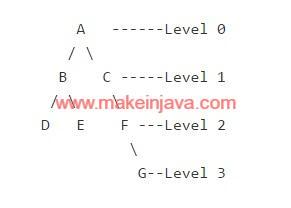
- Level is distance or hops of node with respect to root node.
- The root node is considered to be at level 0 and immediate children of root node will be at level 1 (level of root node + 1).
- We can calculate the level of all the nodes in binary tree (Refer Fig 1).
Example 1: Given a binary tree (Fig 2), Check whether leaf nodes are at same level.
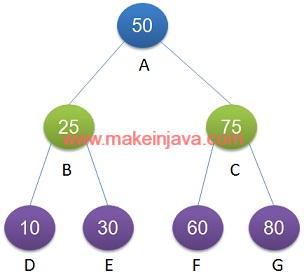
- Traverse the binary tree using breadth first search algorithm.
- Find out the level of each leaf node. (refer below table).
| S. No. | Leaf Node | Level |
|---|---|---|
| 1 | D | 2 |
| 2 | E | 2 |
| 3 | F | 2 |
| 4 | G | 2 |
- Create variable level=0, signify the level of binary tree
- Root is at level 0, push the root to queue.
- Add null to the queue (delimiter to know that we have finished the current level)
- Iterate through the Queue
- Pop node from queue
- Check node is null [The delimiter added earlier]
- We are at next level and increment the level
- Verify that popped up node is leaf node (or not)
- First time, we are visiting the leaf node
- Note down the level of leaf node and mark it visited.
- We got the leaf node again
- Compare the already stored level with current level
- If difference return false
- Compare the already stored level with current level
- Else perform rest operations
- First time, we are visiting the leaf node
- Add next level children (left & right child)
- Once we exit the loop, we will know, whether leaves are same level (or not)
Example 2: Check level of leaf nodes in a given binary tree (Fig 3)
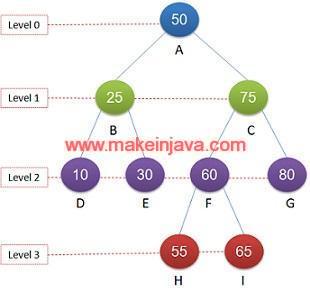
We will follow the similar algorithm for current example and we will find out level of each leaf node.
Time complexity: O(n).
Let us look into the complete code as follows:
1.) IsLeafAtSameLevel Class: IsLeafAtSameLevel class is used to check whether leaf nodes of binary tree are at same level using breadth first search recursive algorithm.
package org.learn.Question;

import java.util.LinkedList;
import java.util.Queue;

public class IsLeavesAtSameLevel {
 public static boolean isLeavesAtSameLevel(Node root) {
  if (root == null) {
   System.out.println("Tree is empty");
   return false;
  }
  Queue<Node> queue = new LinkedList<Node>();
  queue.offer(root);
  // level delimiter
  queue.offer(null);
  int level = 0;
  boolean bLeafFound = false;
  int leafLevel = -1;

  while (!queue.isEmpty()) {
   Node node = queue.poll();
   // Level change
   if (null == node) {
    if (!queue.isEmpty()) {
     // level delimiter
     queue.offer(null);
    }
    level++;
   } else {
    if (node.left == null && node.right == null) {
     // first leaf found
     if (bLeafFound == false) {
      bLeafFound = true;
      leafLevel = level;
     } else { // Leaves are at different level
      if (leafLevel != level) {
       return false;
      }
     }
    }
    if (node.left != null) {
     queue.offer(node.left);
    }
    if (node.right != null) {
     queue.offer(node.right);
    }
   }
  }
  return true;
 }
}
2.) Node Class: Node class representing the nodes of a binary tree. Node class has following attributes
- Data Node
- left child
- right child
package org.learn.Question;

public class Node {
 public int data;
 public Node left;
 public Node right;

 public Node(int num) {
  this.data = num;
  this.left = null;
  this.right = null;
 }

 public Node() {
  this.left = null;
  this.right = null;
 }

 public static Node createNode(int number) {
  return new Node(number);
 }
}
3.) App Class : We are creating the binary tree in main function & we are calling IsLeafAtSameLevel class, to find out whether leaf nodes are at same level using level order traversal.
package org.learn.Client;

import org.learn.Question.IsLeavesAtSameLevel;
import org.learn.Question.Node;

public class App
{
    public static void main( String[] args )
    {
       //root level 0
       Node A = Node.createNode(50);
       //Level 1
       Node B = Node.createNode(25);
       Node C = Node.createNode(75);
       //Level 2
       Node D = Node.createNode(10);
       Node E = Node.createNode(30);
       Node F = Node.createNode(60);
       Node G = Node.createNode(80);
       //Level 3
       Node H = Node.createNode(55);
       Node I = Node.createNode(65);

       //connect Level 0 and 1
       A.left = B;
       A.right = C;
       //connect level 1 and level 2
       B.left = D;
       B.right = E;
       C.left = F;
       C.right = G;

       boolean isLeafAtSameLevel = IsLeavesAtSameLevel.isLeavesAtSameLevel(A);
       if(isLeafAtSameLevel) {
        System.out.println("1. Leaf nodes of binary tree are at same level");
       } else {
        System.out.println("1. Leaf nodes of binary tree are not at same level");
       }

       //Connect level 2 and level 3
       F.left = H;
       F.right = I;
       isLeafAtSameLevel = IsLeavesAtSameLevel.isLeavesAtSameLevel(A);
       if(isLeafAtSameLevel) {
        System.out.println("2. Leaf nodes of binary tree are at same level");
       } else {
        System.out.println("2. Leaf nodes of binary tree are not at same level");
       }
    }
}
The output of main function [Fig 2 and Fig 3] is as follows:
1. Leaf nodes of binary tree are at same level
2. Leaf nodes of binary tree are not at same level
Download Code – Level of leaf node in binary tree (BFS)
