

- Given two single linked lists, find out the intersection point of two single linked lists.
- Traverse the single linked lists using non recursive or iterative algorithm.
- Suppose, we have two linked lists and they meets at certain point
- then, we would like to find out the meeting or join point.
- We have shown two single linked lists, Linked list 1 and linked list 2 in Fig 1.
- Both linked lists are intersected at node 50.
- As per our problem statement, we are interested in Node 50, where two linked lists intersects or joins together.
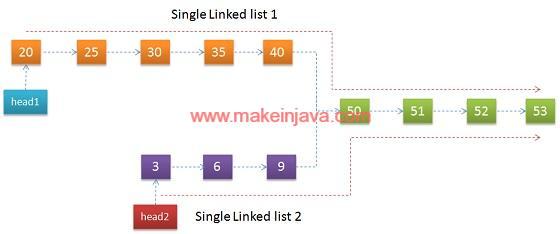
- Let us analyze the single linked lists shown in Fig 1
- Both single linked lists are joined together at node 50
- All the nodes after node 50 are common in both linked list (shown in green color).
- The nodes prior to node 50 differ in both the list i.e. length (or/and data) of lists varies prior to node 50.
- If we can able to find out the difference in length, prior to node 50, then we can figure out the join point of linked lists.
Algorithm – find intersection or join point of two single linked lists in java
- Find out the length of single linked list1 & list2
- length of single linked list1 as shown in Fig 1 is 9
- length of linked single linked list2 is 7
- Find out the differences of length of two linked lists
- difference = length of larger list – length of smaller list
- difference = 9 – 7 => 2
- So, we can reduce two nodes from larger linked list (i.e. Linked list 1)
- then Linked list 1 will become equal to Linked list 2
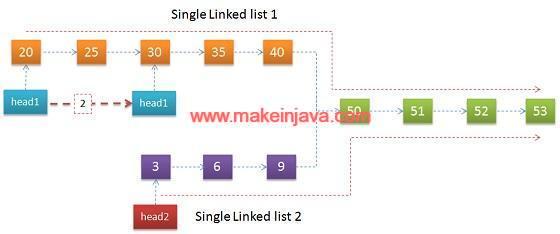
- Move the head pointer of larger list by 2
- We have shown head1 reference shift by 2 in Fig 2
- Now, both head1 (pointing at Node 30) and head2 will travel equal nodes
- i.e Both linked lists will travel 7 nodes
- Compare the address of both nodes during traversal
- Address will be same at Node 50
- So, Node 50 will be join point
- Got the join points of both linked lists
Time complexity of algorithm is O (n).
Program – find intersection or join point of two single linked lists in java
1.) IntersectionPoint Class:
- We are passing head of both single linked lists
- We are finding the join point by calling intersectionPoint method.
package org.learn.Question;

import org.learn.List.Node;

public class IntersectionPoint {
 public static Node intersectionPoint(Node head1, Node head2) {
  int length1 = length(head1);
  int length2 = length(head2);

  Node largerList = null;
  Node smallerList = null;
  if (length1 > length2) {
   largerList = head1;
   smallerList = head2;
  } else {
   largerList = head2;
   smallerList = head1;
  }
  return getIntersetPoint(largerList, smallerList, Math.abs(length1 - length2));
 }

 private static Node getIntersetPoint(Node largerList,Node smallerList,int lengthDifference) {
  int count = 0;
  while (count++ < lengthDifference) {
   largerList = largerList.next;
  }
  while (largerList != null && smallerList != null) {
   if (largerList == smallerList)
    return largerList;
   largerList = largerList.next;
   smallerList = smallerList.next;
  }
  return null;
 }

 public static int length(Node head) {
  int length = 0;
  while (head != null) {
   head = head.next;
   length++;
  }
  return length;
 }

 public static Node insert(Node head, int data) {
  while (head.next != null)
   head = head.next;
  head.next = new Node(data);
  return head.next;
 }

 public static void print(Node head) {
  while (head != null) {
   System.out.printf("%d ", head.data);
   head = head.next;
  }
  System.out.println("");
 }
}
2.) App Class:
- We are creating two single linked lists (head1 and head2) in main method.
- We will print single linked lists.
- Finding the join points of Y shaped linked lists
package org.learn.Client;

import org.learn.List.Node;
import org.learn.Question.IntersectionPoint;

public class App {
 public static void main(String[] args) {
  // List 1 - 20 25 30 35 40
  int[] data1 = { 20, 25, 30, 35, 40 };
  Node head1 = new Node(data1[0]);
  Node lastNodeList1 = null;
  for (int count = 1; count < data1.length; count++) {
   lastNodeList1 = IntersectionPoint.insert(head1, data1[count]);
  }

  // List 2 - 3 6 9
  int[] data2 = { 3, 6, 9 };
  Node head2 = new Node(data2[0]);
  Node lastNodeList2 = null;
  for (int count = 1; count < data2.length; count++) {
   lastNodeList2 = IntersectionPoint.insert(head2, data2[count]);
  }

  // Common Nodes - 50 51 52 53
  int[] commonData = { 50, 51, 52, 53 };
  Node commonList = new Node(commonData[0]);
  for (int count = 1; count < commonData.length; count++) {
   IntersectionPoint.insert(commonList, commonData[count]);
  }

  // 20 25 30 35 40 50 51 52 53
  lastNodeList1.next = commonList;
  // 3 6 9 50 51 52 53
  lastNodeList2.next = commonList;
  System.out.println("1.) Single linked list 1 is :");
  IntersectionPoint.print(head1);
  System.out.println("2.) Single linked list 2 is :");
  IntersectionPoint.print(head2);

  Node intersectNode = IntersectionPoint.intersectionPoint(head1, head2);
  if (null != intersectNode) {
   System.out.printf("3.) Single linked lists-intersected at: %d", intersectNode.data);
  } else {
   System.out.println("3.) Single linked lists are not intersected");
  }
 }
}
3.) Node Class:
- Node class representing the node (s) of single linked lists.
package org.learn.List;

public class Node {
 public int data;
 public Node next;

 public Node(int num) {
  this.data = num;
  this.next = null;
 }
}
Output – intersection or join points of two single linked lists in java
1.) Single linked list 1 is :
20 25 30 35 40 50 51 52 53
2.) Single linked list 2 is :
3 6 9 50 51 52 53
3.) Single linked lists are intersected at: 50
Download Code – Intersection / join point of two single linked lists
